Sudan
Eighteen states
Pick a state on the map to see its capital, area and population.
Khartoum
Capital: Khartoum
- Area
- 22,142 km²
- Population (2018)
- 7,993,900
About Sudan
Sudan, in Northeast Africa, is an Arab-African nation with a uniquely diverse social fabric — many cultures, ethnicities and traditions living side by side. It is the continent's third-largest country and is traversed by the River Nile.
Imagery: NASA Blue Marble · State boundaries: OCHA (CC BY 3.0 IGO) · Rivers: Natural Earth
Sudan
Pick a state on the map to see its capital, area and population.
Capital: Khartoum
The land
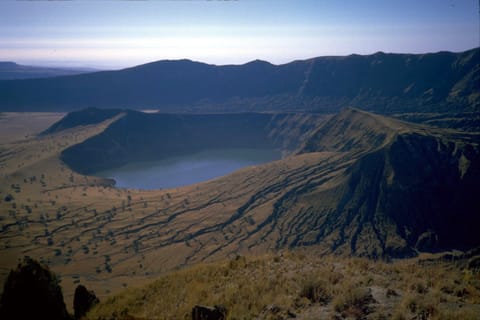
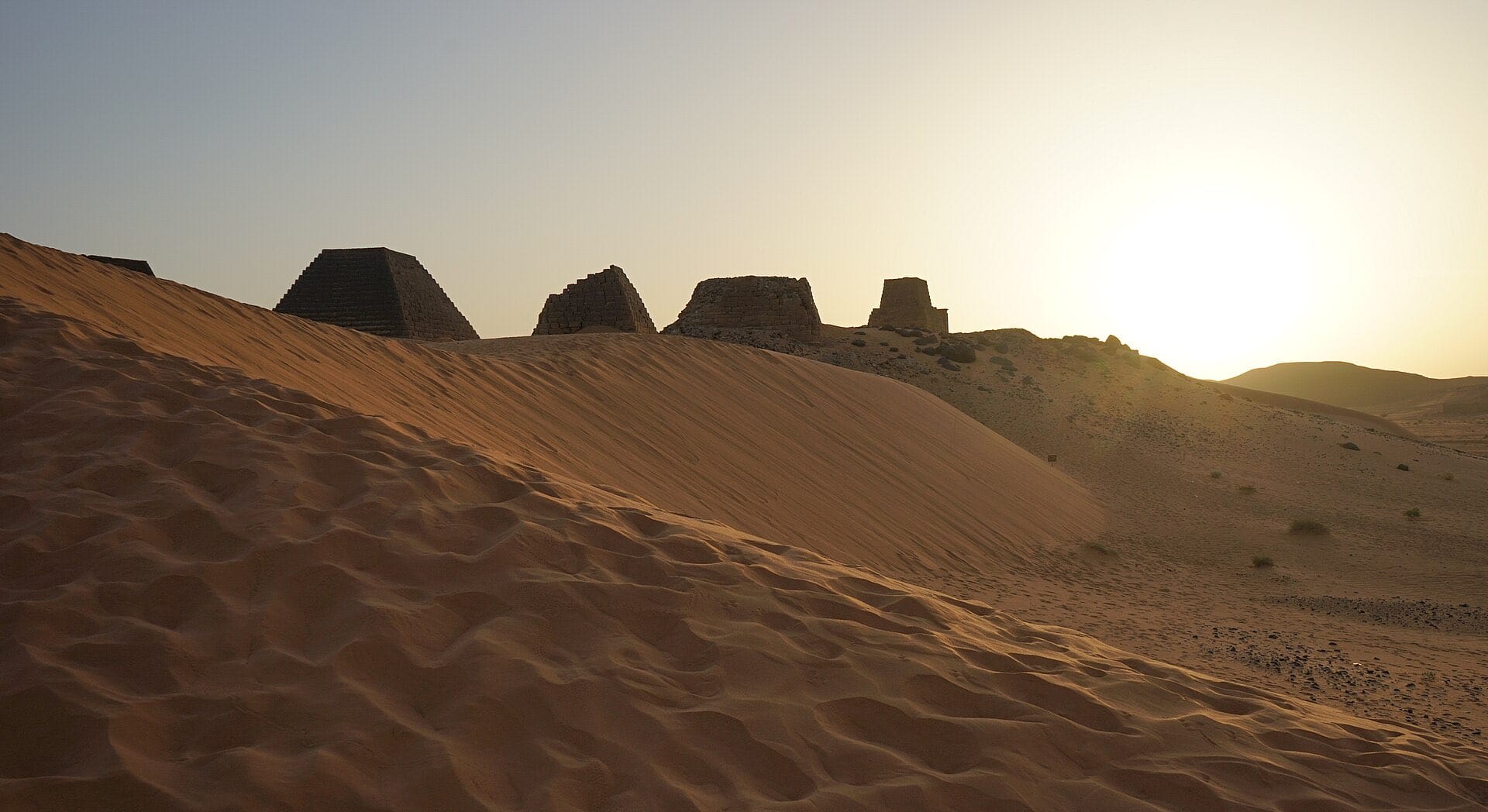
Desert, savanna, volcanic highlands and fertile river plains.
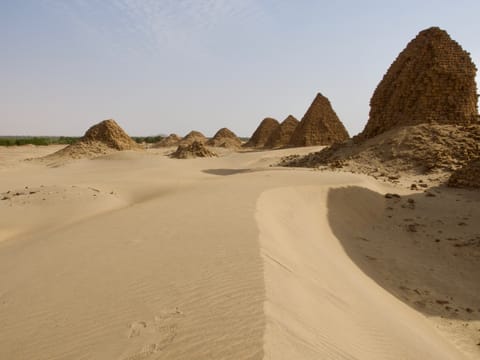
Kerma, Kush and Meroë — kingdoms that shaped the Nile valley for millennia.
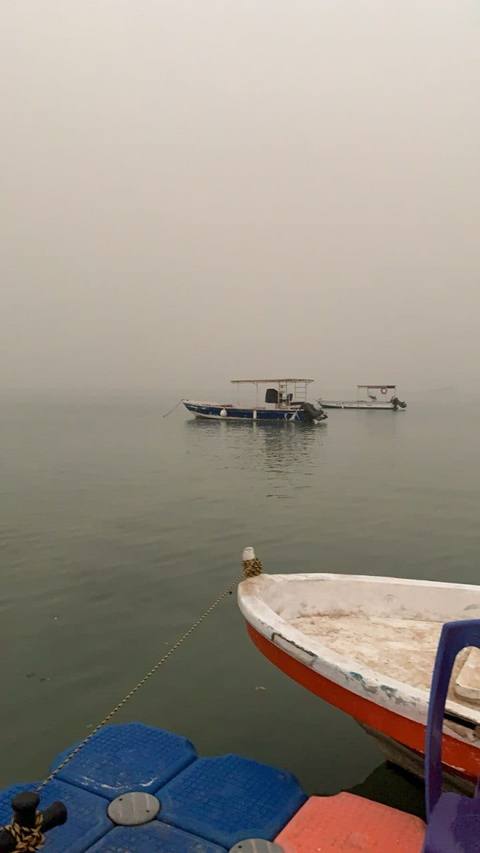
Some 750 km of coastline, coral reefs and the marine parks of Sanganeb and Dungonab Bay.
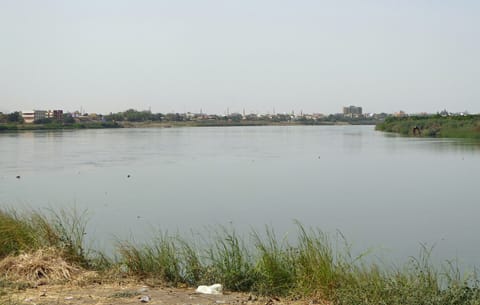
The Blue and White Nile meet at Khartoum and carry farming, fishing and trade.
Sudan lies roughly between latitudes 8.45°N and 23.8°N and longitudes 21.49°E and 38.24°E. Its climate is tropical — extremely arid in the north, semi-humid in the south — with annual rainfall ranging from almost none in the north to 500–1000 mm in the south. The Nile and its tributaries are central to the country's economy, society and culture, supporting agriculture, fishing, navigation and hydroelectric power.
Along the Nile, the Kingdom of Kush flourished and Kushite kings ruled Egypt as the 25th Dynasty, later centring their kingdom at Meroe. From the 6th century the three Nubian kingdoms of Nobatia, Makuria and Alodia adopted Christianity, while Islam reached the Red Sea coast by the 7th century and spread through trade and settlement. After the work of the 1938 Graduates' Conference and the parliamentary declaration of 19 December 1955, Sudan became independent on 1 January 1956.
Khartoum is a "triple capital" formed by three cities where the Blue and White Nile meet: Khartoum (the political centre), Omdurman (the national and cultural heart) and Khartoum North / Bahri (the industrial centre).
Sudan's principal resources and exports include petroleum, livestock, gum arabic, cotton, oilseeds and gold. Its federal, decentralised government spans 18 states, Arabic and English are the official languages, and the currency is the Sudanese Pound (SDG).
National symbols
Red, white and black bands with a green triangle at the hoist, adopted on 20 May 1970.
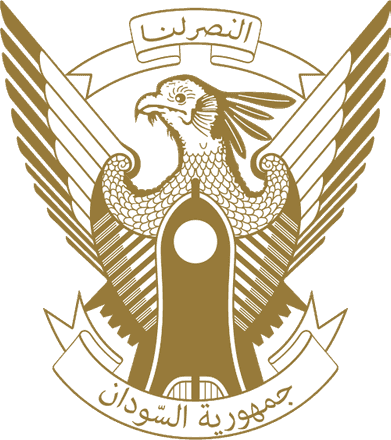
A secretary bird bearing a shield, with the motto “Victory is ours” above it. The bird, which hunts on foot across the savanna, was chosen for its strength, pride and high flight.
“We are the soldiers of God, the soldiers of the homeland” — the national anthem since independence in 1956.
Culture
Sudanese culture is carried by poetry, music, crafts and an everyday hospitality that brings families and neighbours together around coffee.
Culture and community eventsArts and letters
Tayeb Salih’s Season of Migration to the North (1966) is a classic of Arabic fiction. Poets such as al-Tijani Yusuf Bashir and Muhammad al-Fayturi, and novelist Leila Aboulela, carry the tradition on.
Built on the five-note scale, Sudanese song grew from the haqiba of the 1920s to the modern orchestras of Mohammed Wardi, Sayed Khalifa and Ibrahim Awad, carried by Omdurman Radio from 1940.
The Khartoum School of Ibrahim El-Salahi and Ahmed Shibrain fused Arabic calligraphy with African forms; Kamala Ibrahim Ishaq co-founded the Crystalist movement.
From Ibrahim Shaddad’s early films to Amjad Abu Alala’s You Will Die at Twenty (Venice, 2019) and Mohamed Kordofani’s Goodbye Julia (Cannes, 2023), Sudanese cinema has won international prizes.
Learning began in the khalwa Quran schools. Babikr Badri opened the first girls’ school in Rufaa in 1907, and Gordon Memorial College (1902) became the University of Khartoum in 1956.
Khalid Abu al-Rous’s play Tajouj (1934) drew on a folk love story. The National Theatre in Omdurman, opened in 1958, launched a generation of directors and actors.
Every region has its own dances for harvests and weddings — the kambala of the Nuba Mountains, the mardoum of Kordofan — often led by the hakkamat, women singers of praise and satire.
Gourds, leather, palm fronds and wool are worked into bowls, mats, baskets and saddlery — everyday objects that carry each community’s patterns.
Languages
Arabic and English are the official languages. Alongside them, dozens of languages are spoken across the regions — a selection:
Sudan 101
More than 200 Nubian pyramids stand at Meroë, Nuri, El-Kurru and Jebel Barkal.
Jebel Barkal and the Napatan sites, the Island of Meroë, and Sanganeb and Dungonab Bay.
The Blue Nile from Ethiopia and the White Nile join at Al-Mogran in Khartoum.
Sudan is a leading producer of gum arabic, used in food and medicine worldwide.
History
One of Africa’s earliest urban states rises at the Third Cataract of the Nile.
Kushite kings from Napata, near Jebel Barkal, rule Egypt as its 25th Dynasty.
The royal capital moves to Meroë, a centre of iron-working with its own Meroitic script.
The Nubian kingdoms of Nobatia, Makuria and Alodia adopt Christianity; Old Nubian is written down.
Islam reaches the Red Sea coast and spreads gradually inland through trade and settlement.
The Funj Sultanate is founded at Sennar on the Blue Nile.
The Mahdist movement founds a state with its capital at Omdurman.
Educated Sudanese found the Graduates’ General Congress, the forerunner of the independence movement.
After Parliament’s declaration of 19 December 1955, the flag of independent Sudan is raised.
Heritage
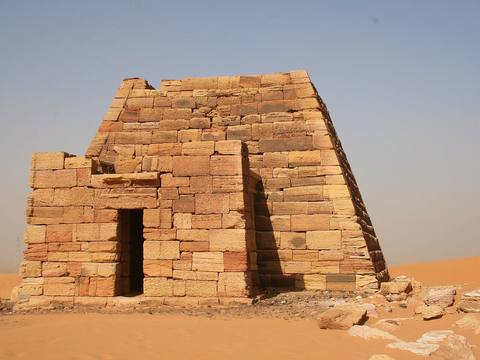
Royal city and necropolis of the Kushite kingdom.
Open the state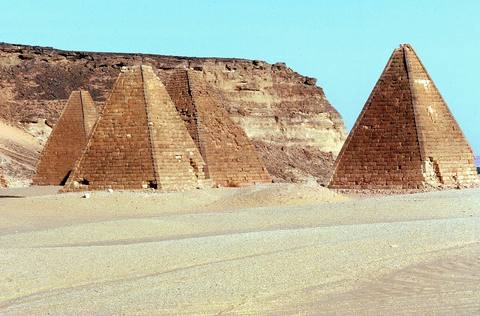
Sacred mountain of Napata, with temples and pyramids at its foot.
Open the state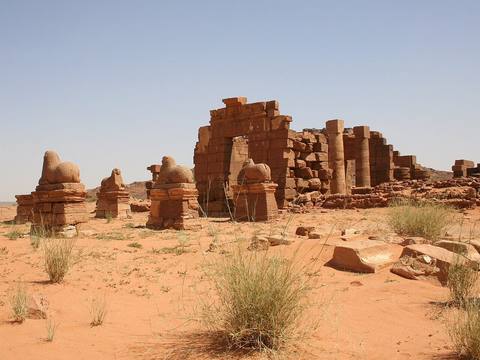
Meroitic temples of Amun and Apedemak in the Butana.
Open the state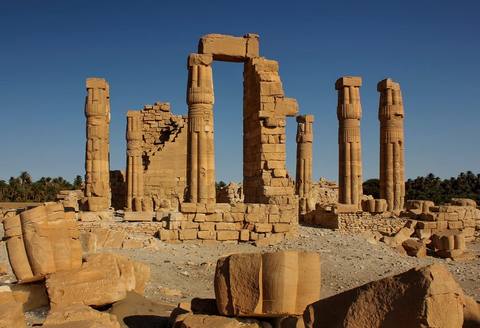
Temple built under Amenhotep III on the Nile in Nubia.
Open the state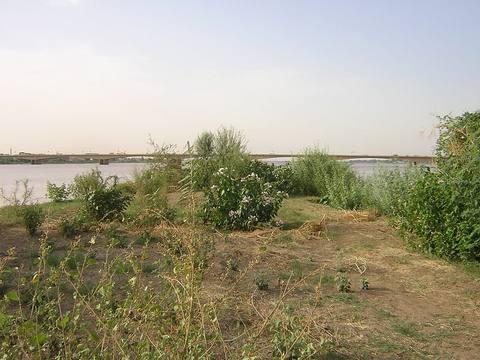
The triple capital at the confluence of the Niles.
Open the statePhoto: Wikimedia Commons — see image credits.
Economy and trade
Some 850 km of Red Sea coast and seven neighbours make Sudan a natural route to the sea for inland Africa, on the shipping lane to the Suez Canal.
Vast arable land fed by the Nile, seasonal rains and groundwater, with large herds of livestock — the base of the country’s farming economy.
Gold is the leading export, alongside other minerals and oil; gum arabic, sesame and livestock round out the export basket.
Sudan is a member of COMESA, the Common Market for Eastern and Southern Africa, and holds trade agreements with its neighbours.
Investment rules and incentives change. For current guidance on trade and investment with Sudan, contact the embassy.
Sudan is organised into 18 states, each with its own capital and administration. Select a state to read more about it.
Before you travel
State figures from Wikipedia (opens in a new tab).